Showing posts with label Grid. Show all posts

Sunday, June 6, 2010

Using Ice to Cool Down the Grid

Utilities are installing devices that make ice at night to replace air-conditioning during times of peak power demand.

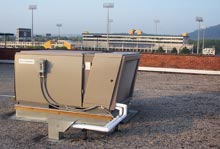
Over the next few weeks, a consortium of municipal utilities in California will begin retrofitting government offices and commercial properties with systems that use ice made at night to replace air-conditioning during the day. It's part of a pilot program for the devices, which are built by Windsor, CO-based Ice Energy. If widely deployed, they could reduce fuel consumption by utilities by up to 30 percent and put off the need for new power plants.  

Each Ice Energy device is designed to make ice overnight, when demand for electricity is low, using a high-efficiency compressor to freeze 450 gallons of water. Around midday, the cooling mode kicks in, and the device shuts off the building's regular air conditioner for a six-hour cycle. It pipes a stream of coolant from the slowly melting block of ice to an evaporator coil installed within the building's heating, ventilation, and air-conditioning blower system. Once the ice is melted, the air conditioner returns to normal operation. Brian Parsonnet, Ice Energy's chief technology officer, says the technology can cut a building's power consumption by 95 percent during peak hours on the hottest days.

Cutting demand for electricity during peak hours reduces the need to build new power plants. It also allows utilities to rely on their most efficient power plants, says Ronald Domitrovic, a senior project manager for electric utilization at the Electric Power Research Institute. He says that when utilities fire up their "least efficient, oldest, and least desirable" generating resources to meet peak demand, every increment of increased power on the grid sends costs surging, whether one is talking fuel costs, greenhouse gas emissions, or service reliability. However, at night, utilities draw on their most efficient power plants, which use less fuel than power plants used only during peak hours. The utility also saves energy at other points in the grid--for example, cooler power lines at night transmit electricity more efficiently.

Source:   Technology Review                   Read full article here.
By David Richardson

Sunday, May 30, 2010

NREL Study Shows US Grid Can Accommodate Large Amounts of Solar

The National Renewable Energy Laboratory (NREL) has released the Western Wind and Solar Integration Study, an initial study assessing the operational impacts and economics of increased contributions from wind and solar energy producers on the power grid.

The study specifically focuses on the operational impacts of photovoltaics, concentrating solar power (CSP) and wind on the power system operated by the WestConnect group of utilities in the Mountain and Southwest states. WestConnect is a group of transmission providers including Arizona Public Service, El Paso Electric Co., NV Energy, Public Service of New Mexico, Salt River Project, Tri-State Generation and Transmission Cooperative, Tucson Electric Power, Western Area Power Administration, and Xcel Energy.

The study examines the benefits and challenges of integrating enough solar and wind energy capacity onto the grid to produce 35% of its electricity by 2017. This target is technically feasible and does not necessitate extensive additional infrastructure, but it does require key changes to current operational practice, NREL says.

The results offer a first look at the issue of adding a significant amount of variable renewable energy in the West and will help utilities across the region plan how to ramp up their production of renewable energy as they incorporate more solar and wind plants into the power grid.

Technical analysis performed showed that it is operationally possible to accommodate 30% wind and 5% solar energy penetration. To accomplish such an increase, utilities will have to substantially increase their coordination of operations over wider geographic areas and schedule their generation deliveries, or sales, on a more frequent basis, NREL notes.

Currently, generators provide a schedule for a specific amount of power they will provide in the next hour. More frequent scheduling would allow generators to adjust that amount of power based on changes in system conditions, such as increases or decreases in solar or wind generation.

The study also finds that if utilities generate 27% of their electricity from wind and solar energy across the Western Interconnection, it would lower carbon emissions by 25% to 45%. It would also decrease fuel and emissions costs by 40%, depending on the future price of natural gas.

Other key findings from the study include the following:

- Existing transmission capacity can be more fully utilized to reduce the amount of new transmission that needs to be built;

- To facilitate the integration of solar and wind energy, coordinating the operations of utilities can provide substantial savings by reducing the need for additional backup generation, such as natural gas-burning plants;

- Use of solar and wind forecasts in utility operations to predict when and where it will be sunny and windy is essential for cost-effectively integrating these renewable energy sources.

The full study can be downloaded at www.nrel.gov/wwsis.