Microsoft founder Bill Gates on Tuesday warned rich nations of the limitations of "cute" energy-efficient technologies, like individual solar panels, and advised spending more money on R&D to make energy cheaper for developing countries.
During a keynote on energy innovation at the Wired Business Conference 2011 in New York City, Gates said the only pure efficiency that comes from using energy-efficient technologies like LED lights, solar panels, and heating-efficient buildings, is economic.
"Can we, by increasing efficiency [technologies], deal with our climate problem?" he asked. "The answer there is basically no, because the climate problem requires more than 90 percent reduction of C02 emitted, and no amount of efficiency improvement is enough," he said.
Every year developed countries improve energy efficiency, but it is almost entirely offset by the voracious energy consumption of developing countries, he added.
"With the CO2 problem, even if the rich world did very erratic things it doesn't come anywhere near to solving the problem. You have to help the rest of the world get energy at a very reasonable price to get anywhere," he said. Instead of spending money on subsidizing old energy technologies, Gates said the role of the rich world is to talk about long-term problems and fund the R&D to find solutions. But there's a Catch-22 here, given that most Americans don't grow their own food or have any first-hand knowledge of how climate change affects things like food production.
"The problem is that rich countries can afford to overpay for things. We can afford to overpay for medicine, energy, we can rig our food prices," he said. "Our politicians aren't told that we're suffering because we're overpaying for things."
Gates claimed that over 90 percent of energy subsidies actually went into deploying old technology instead of R&D. "You can buy as much old technology as you want, but you won't get breakthroughs which only come out of basic research."
When it comes to energy sources, Gates' preferences are well-known. In recent years he has invested hundreds of millions in nuclear energy start-ups, like the Bellevue, Washington-based nuclear reactor plant TerraPower, which has built a prototype for a nuclear reactor that can supposedly run for 50 years without refueling.
"The good news about nuclear is that there's hardly been any innovation, so the room to do things differently has been quite dramatic," he said, arguing that the amount of waste generated by nuclear plants is "tiny" compared to coal plants.
What happened in Fukushima was terrible, but preventable with newer technology, he said, noting that the nuclear power plants there were built in the 1960s. "The emergency plants were weak," he said.
Showing posts with label Research. Show all posts
Showing posts with label Research. Show all posts
Wednesday, May 4, 2011

Monday, June 7, 2010
AUO Introduces Self-Cleaning Smart Module
AU Optronics Corp. (AUO) has developed the Smart Module, a photovoltaic module featuring a layer of thin film coated on the surface that is designed to reduce reflection and increase both ray transmission and the module's power generation. The product will be formally unveiled at the upcoming Intersolar conference in Munich, Germany.
The thin-film coating also features a self-cleaning ability to dissolve foreign particles on the PV module, thereby keeping the surface of the PV module clean, the company notes. According to AUO, a PV system using the Smart Module during the initial operation can increase power generation by about 3%; three months after installation, the power generation can increase by about 4%.
The thin-film coating also features a self-cleaning ability to dissolve foreign particles on the PV module, thereby keeping the surface of the PV module clean, the company notes. According to AUO, a PV system using the Smart Module during the initial operation can increase power generation by about 3%; three months after installation, the power generation can increase by about 4%.
Sunday, June 6, 2010
Solon Introduces Global Solar Test Sites
SOLON Corp., a crystalline silicon solar manufacturer and a provider of turnkey solar power plants, has unveiled its Global Test Site (GTS) Network.
Consisting of three identical outdoor proving grounds located in Tucson, Ariz.; San Pietro, Italy; and Berlin, Germany, the GTS Network gives SOLON the ability to test and understand regional affects on PV modules and related technologies to optimize module and system design, the company explains.
Regional factors such as temperature, humidity, wind, snow and dust can significantly affect the performance of solar PV modules. At the solar test facilities, SOLON will study various areas of performance on four platforms: fixed-tilt at zero degrees, fixed-tilt at latitude, single-axis tracking and dual-axis tracking.
A custom data acquisition system will be used to measure voltage and current before and after the inverter, as well as cell temperature, ambient temperature, irradiance (direct and diffuse), wind speed and humidity. This information is stored on a central server, which allows SOLON scientists from around the world to access and analyze the performance of the modules at all three facilities.
SOURCE: SOLON Corp.
Consisting of three identical outdoor proving grounds located in Tucson, Ariz.; San Pietro, Italy; and Berlin, Germany, the GTS Network gives SOLON the ability to test and understand regional affects on PV modules and related technologies to optimize module and system design, the company explains.
Regional factors such as temperature, humidity, wind, snow and dust can significantly affect the performance of solar PV modules. At the solar test facilities, SOLON will study various areas of performance on four platforms: fixed-tilt at zero degrees, fixed-tilt at latitude, single-axis tracking and dual-axis tracking.
A custom data acquisition system will be used to measure voltage and current before and after the inverter, as well as cell temperature, ambient temperature, irradiance (direct and diffuse), wind speed and humidity. This information is stored on a central server, which allows SOLON scientists from around the world to access and analyze the performance of the modules at all three facilities.
SOURCE: SOLON Corp.
Using Ice to Cool Down the Grid
Utilities are installing devices that make ice at night to replace air-conditioning during times of peak power demand.

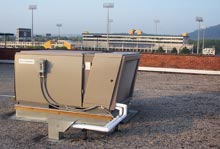
Over the next few weeks, a consortium of municipal utilities in California will begin retrofitting government offices and commercial properties with systems that use ice made at night to replace air-conditioning during the day. It's part of a pilot program for the devices, which are built by Windsor, CO-based Ice Energy. If widely deployed, they could reduce fuel consumption by utilities by up to 30 percent and put off the need for new power plants.
Each Ice Energy device is designed to make ice overnight, when demand for electricity is low, using a high-efficiency compressor to freeze 450 gallons of water. Around midday, the cooling mode kicks in, and the device shuts off the building's regular air conditioner for a six-hour cycle. It pipes a stream of coolant from the slowly melting block of ice to an evaporator coil installed within the building's heating, ventilation, and air-conditioning blower system. Once the ice is melted, the air conditioner returns to normal operation. Brian Parsonnet, Ice Energy's chief technology officer, says the technology can cut a building's power consumption by 95 percent during peak hours on the hottest days.
Cutting demand for electricity during peak hours reduces the need to build new power plants. It also allows utilities to rely on their most efficient power plants, says Ronald Domitrovic, a senior project manager for electric utilization at the Electric Power Research Institute. He says that when utilities fire up their "least efficient, oldest, and least desirable" generating resources to meet peak demand, every increment of increased power on the grid sends costs surging, whether one is talking fuel costs, greenhouse gas emissions, or service reliability. However, at night, utilities draw on their most efficient power plants, which use less fuel than power plants used only during peak hours. The utility also saves energy at other points in the grid--for example, cooler power lines at night transmit electricity more efficiently.
Source: Technology Review Read full article here.
By David Richardson
Sunday, May 30, 2010
Higher CO2 Leads to Lower Protein Content in Grains
A new study published in the journal Science states that rising CO2 levels in the atmosphere aren't just affecting climate, but could affect the nutrition contained in the world's food crops too. Scientists at the University of California, Davis found that increased CO2 could reduce the protein content of crop plants by as much as 20 percent.
This slash in nutritional value happens because higher concentrations of CO2 interfere with a plant's ability to convert nitrates into proteins, which leads to a less protein-rich food.
The scientists tested two common forms of soil nitrogen (nitrate and ammonium) with wheat plants that were exposed to elevated CO2 and the plants had reduced abilities to produce proteins.
Going Solar is an excellent way to reduce CO2 levels -
Source: EcoGeek
This slash in nutritional value happens because higher concentrations of CO2 interfere with a plant's ability to convert nitrates into proteins, which leads to a less protein-rich food.
The scientists tested two common forms of soil nitrogen (nitrate and ammonium) with wheat plants that were exposed to elevated CO2 and the plants had reduced abilities to produce proteins.
Going Solar is an excellent way to reduce CO2 levels -
Source: EcoGeek
Wednesday, May 19, 2010
US DOE Releases $62 Million for CSP R&D
Department of Energy Secretary Steven Chu late last week announced the selections of projects for investment of up to US $62 million over five years to research, develop, and demonstrate Concentrating Solar Power (CSP) systems capable of providing low-cost electrical power.
The thirteen DOE award selections fall into two areas, CSP system studies and component feasability studies. The award winners, along with their projects and the amount of each award are available by clicking on the link below:
The thirteen DOE award selections fall into two areas, CSP system studies and component feasability studies. The award winners, along with their projects and the amount of each award are available by clicking on the link below:
Subscribe to:
Posts (Atom)