Showing posts with label Solar Research. Show all posts

Wednesday, May 4, 2011

Small Scale Solar Thermoelectric Device Prototype Developed

Solar thermal based electricity generation tends to conjures an image of a baking desert plain filled with shining mirrors; each reflecting and concentrating sunlight onto a collection point mounted at the pinnacle of a gleaming tower, where the concentrated sunlight's heat is used to create steam and drive turbines that produce electricity.

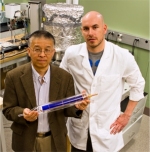
A collaborative research team from the Massachusetts Institute of Technology (MIT) and Boston College have developed a small-scale thermoelectric solar device that uses flat-panel technology - much like conventional silicon photovoltaic solar panels - to harness the sun's heat and produce power up to eight times more efficiently than other devices based on solar thermoelectric technology.

The beauty of the device, according to MIT Professor in Power Engineering, Gang Chen, lies in its simplicity. Like a photovoltaic module based system, it has no moving parts. The device consists of a thermoelectric generator placed inside a vacuum chamber made of glass, covered with a black plate of copper that absorbs sunlight but does not re-radiate it as heat. The other side of the generator is in contact with ambient temperatures. Even when not in direct sunlight, the generator is capable of harnessing a temperature difference of 200 degrees Celsius between the interior and exterior of the system to generate electricity.

The concept "is very radical," Chen says, and because the MIT device requires much less expensive materials to manufacture than traditional solar panels, the cost vs. energy output could become a superior clean energy choice in the future once the technology is properly developed.

By installing small-scale solar thermoelectric devices onto existing solar hot water systems, households could also produce electricity and further reduce greenhouse gas emissions.

Li Shi, associate professor of mechanical engineering at the University of Texas at Austin, says the thermoelectric approach to solar power is "very novel, simple, and easy for low-cost implementation." The efficiency level they have demonstrated so far, at 4.6 percent, is "already quite impressive," he says.

Source:   Energy Matters

Sunday, March 13, 2011

Purdue Research Cracks Both Of Solar Energy’s Roadblocks, Road Opens In 2013


Whenever I overhear conversations on the environment, the common consensus is always, “why don’t they just put solar panels everywhere?” As much as that would be the most optimistic scenario, there have been and still are some serious road blocks to widespread solar panel use: efficiency and cost.

The theory of lowering cost is easy. Increase production efficiency, and panel cost will lower — this is mostly straightforward, but of course, takes some time. Increasing solar efficiency (the amount of the sun’s photons that convert to electrical energy) doesn’t have such a straight forward process.

Nonetheless, humans have prevailed and it seems a few scientists at Purdue University have completed some research to improve both the cell and production efficiencies of solar panels. By using lasers to scribe microchannels in the cells, the researchers were able to improve the efficiency of inter-cell power transfer, thereby increasing overall efficiency of multi-cell thin-film solar cells.

Current solar panels are made in ways not dissimilar to microprocessor production: evaporating metals onto semiconductor substrates. The Purdue research found that cell-interconnects, made of the evaporated metals, were found to be a large source of energy loss. In order to find better materials for these cell-interconnect, the researchers turned to conducting polymers; which are getting very popular.

Conducting polymers can be made thin, transparent and flexible; perfect for solar cells as they require less material and lower costs. However, this theory required a new process to create the cells. The Purdue research purportedly is the first time lasers were used to successfully to create the interconnects. Yung Shin, professor at Purdue who led the study said, “The efficiency of solar cells depends largely on how accurate your scribing of microchannels is. If they are made as accurately as possibly, efficiency goes up.”

The ultra-fast lasers are able to create pulses lasting only picoseconds without overheating the material, creating silky smooth and sharp channels. “It creates very clean microchannels on the surface of each layer. You can do this at very high speed, meters per second, which is not possible with a mechanical scribe. This is very tricky because the laser must be precisely controlled so that it penetrates only one layer of the thin film at a time, and the layers are extremely thin. You can do that with this kind of laser because you have a very precise control of the depth, to about 10 to 20 nanometers,” said Yung Shin.

Expect to see this research make its way into the private sector in order to increase thin film cell production from 20% today to 31% in just two years.

The team has published a paper on their work at the 2011 NSF Engineering Research and Innovation Conference in January.

[via dailytech]

Wednesday, February 16, 2011

The Importance of Solar Research to the PV Industry

The PV industry is a huge success story today, with new companies shooting up like mushrooms and big companies shifting their gears towards this Holy Land of dollars. A crucial factor enabling this double-digit yearly growth is the incentives of European countries and, in particular, of the German government.

From a research point of view, new themes that will be important in 2011 are the study of new PV materials.

Thanks to this success, these incentives will be cut down at a faster pace than originally anticipated. To maintain a strong and sustainable PV market and ensure returns on the large investments that PV companies have made worldwide, grid parity has to be reached as soon as possible.

Without continued technological improvements, the PV industry may fall from its current heights like Icarus when he got too close to the sun. Here are some thoughts on how to improve:

For both bulk silicon solar cells and thin-film solar cells, it will be key to achieve a rise in solar cell efficiencies at an accelerated pace and a cost reduction. This does not necessarily imply immediate revolutionary changes. For bulk solar cells for example, the efficiency can be increased by contacting of shallow emitters and decoupling of front and rear side processing. These technologies are available for development and deployment by the industry. It will be crucial to guarantee the reliability of these solutions.

In general, an accelerated transfer of new technologies from lab to industry is key to maintaining a stable market after the incentives have faded out. Within this respect, it is important that interaction between research institutes and companies is increased and reinforced. Suitable business models for cooperation will have to be worked out. One such example is imec’s affiliation program in which different companies work together to develop new generic technologies to increase efficiency and reduce cost of bulk and thin-film solar cells. The sharing of risk and cost makes it an attractive business model to partners.

From a research point of view, new themes that will be important in 2011 are the study of new PV materials. These are necessary to replace materials that are suspected to be hampered by a limited supply in the future. If we want to be ready when the time of shortage comes, we have to start studying the possibilities today. For example, think of the replacement of silver contacts by copper contacts: if we want to develop a reliable solution to this problem, we have to start studying the possibilities now.

Imec is working to reduce the thickness of the active silicon layer from 150μm down to 40μm. This will substantially lower the production cost of crystalline Si solar cells.

To reach efficiencies of more than 20% on such large-area thin wafers, imec has introduced alternative back-side dielectric stacks using a PERL-style (passivated emitter and rear local back surface field) passivation, and interdigitated back-side contacts (i-BC), both in an industrial process flow.

It's important to investigate the integration of these new cells in modules, as reduced wafer thickness will impose specific integration requirements. Work on and assesing the reliability of the cells is also important, as the cells will need a guaranteed lifetime of up to 25 years.

Imec has also developed epitaxial thin-film (<20μm) silicon solar cells grown on low-cost silicon carriers. The process to fabricate such epitaxial thin-film cells on low-cost silicon carriers is generically similar to the bulk process, so an epi-process can be implemented with limited equipment investment in existing manufacturing lines.

Given the guarantees on lifetime and stability of PV modules, it should be emphasized that no technological innovation in photovoltaics can make it without a thorough assessment of reliability. However, with a well-thought choice of R&D topics, a large focus on reliability of new technologies, and an accelerated transfer of lab results to the industry, I believe PV industry can continue its growth path even within the context of rapidly decreasing incentives, and remain a booming business.

Jef Poortmans is the Program Director of the Strategic Programme SOLAR+ at IMEC.

Wednesday, February 9, 2011

EPIR Technologies Creates Polycrystalline CdTe Solar Cells on Glass

EPIR Technologies Inc. says it has repeatedly fabricated high-efficiency polycrystalline cadmium telluride (CdTe) solar cells on commercial glass substrates. The company has been working with a team of scientists from the National Renewable Energy Laboratory (NREL), notes Siva Sivananthan, founder and CEO of EPIR Technologies.

According to Chollada Gilmore, EPIR's CdTe solar cell technical lead, the cell was officially verified by NREL at 15.2 % efficiency. The high efficiency was driven by a fill factor of 77.6%, and the cells were fabricated using inexpensive commercial TEC-series glass substrates rather than technical-grade glass.

SOURCE: EPIR Technologies Inc.


Note:   First Solar modules have an efficiency of 10.6% ... so this represents a major improvement if it can be mass produced.

Thursday, November 18, 2010

Five Ways to Harvest Solar Energy from Roads


Solar News:


Knowing what we know now about climate change, it's clear that the tangled web of black asphalt roads that outlines our country is working against us.  Asphalt can absorbs tons of heat, often reaching temperatures of up to 140 degrees in the summer and the process by which it's made isn't environmentally friendly either, but there may be a way to turn that pavement into an energy resource.


Researchers at the University of Rhode Island have come up with four ways to harness the solar energy absorbed by pavement and put it to good use and they're working on ways to implement them now.


The first, and the simplest, is is to wrap flexible solar PV cells around the top of Jersey barriers that divide highways.  Those cells would power streetlights and illuminate road signs.  Cells could also be embedded in the pavement between the barriers and rumble strip.


The second is to embed water-filled pipes under the asphalt and the heat from the sun would warm the water.  That water could be piped to bridges to melt ice and reduce the need for road salt and ice-clearing trucks.  It could also be piped to nearby buildings for hot water and heating needs or converted to steam to turn a turbine. Because asphalt retains heat really well, the pipes would stay warm even after sunset.  Tests have shown the water can even get hotter than the asphalt.


The third use is to use a thermo-electric effect to generate energy.  By linking a hot and cold spot with two types of semiconductors, a small amount of electricity can be generated in the circuit.  Those thermo-electric materials could be embedded in the road (some in sunny parts and some in shady ones) and the energy produced could be used could to defrost roads.


The fourth use is the most complex and it involves getting rid of the asphalt completely and replacing it with huge electronic blocks that contain PV cells, LED lights and sensors.  The blocks would generate electricity, illuminate lanes and emit warnings when maintenance was needed.  The researchers say this technology already exists but is very expensive.  They see this technology coming to parking lots before roadways.


Souce:   EcoGeek & Physorg


Views:   The original article focused on the four methods mentioned above -- but for readers of this blog - we wanted to bring your attention to a fifth method that is showing great promise -- convert the kinetic motion of the cars and trucks into electricity -- see my earlier blog on New Energy Technologies - Motion Power™ this is their "other" technology - and it is also quite impressive.

Tuesday, November 2, 2010

Some day, luminescent solar lasers may power photovoltaic cells


Rochester, NY--At the Optical Society of America's Frontiers in Optics 2010 this week, Carmen Rotschild, a researcher at the Massachusetts Institute of Technology (MIT; Cambridge, MA) discussed what could be the next step beyond the luminescent solar concentrator (LSC): the luminescent solar laser.
In the Photonics and Energy I technical session, Rotschild outlined the work groups at MIT and the University of Michigan have done so far to make such a laser practical.
In a conventional incoherent LSC, a slab of clear plastic is doped with a dye that absorbs sunlight and reradiates it in a longer-wavelength band; the reradiated light (or part of it, at least) makes its way via total internal reflection to the edge of the slab, where it is collected by a long, thin photovoltaic (PV) cell.  Incoherent LSCs have some remarkable qualities--for example, they reach reasonably high concentrations without having to track the sun, and can even concentrate light on a completely cloudy day. However, because the dye in the slab reradiates light in all directions, part of the light escapes the slab, lowering efficiency.
If such a setup could be made to lase rather than simply re-emit incoherently, then the radiation would be emitted within a very narrow angle and would thus all be channelled to the PV cell.
So Rotschild and colleagues are creating microring lasers made of three materials, with one layer's output-wavelength band matching the next layer's absorption-wavelength band.  First, a very thin outer coating absorbs and re-emits very efficiently, but also does not transmit the light very well--which is not a problem, because the coating is so thin.  Next, a second material absorbs the first layer's output and re-emits it (at a longer wavelength), and has a longer transmission length, which allows the light to get into the laser cavity, which has a high Q factor.  Finally, the laser cavity itself, which has a very low absorbance but is compensated for this by its high Q, absorbs the light from the second material and produces laser light.
Early experimental results are encouraging, but much more research on device materials and geometry is needed before practical solar-energy-collecting lasers can be created.  However, the potential of cheap, highly efficient solar concentrators that require very little PV area and can concentrate light on cloudy days makes this project one of the most interesting variations on the LSC theme.
Source:  ElectroIQ

Saturday, September 18, 2010

New Glass Coating Holds Promise for Solar Panels


Research company Tecnalia, with the University of Cantabria in Spain, made a new glass coating for photovoltaic solar cells that can enhance the performance of the device.
Solar cell coatings are currently made of materials not optimized for absorbing high-frequency radiation.

Tecnalia’s Sunglass project is focusing on improving solar cells’ conversion of frequencies, the ability to absorb photons of certain frequencies and emitting these afterwards in another range of frequency.
With this, the researchers hope to increase the performance of solar panels, which on the average have a solar conversion efficiency of around 15 percent.

The Sunglass project aims to develop a new coating, as well as an entire solar module product.
The researchers examined various photoactive substances to determine the substances’ capacity to absorb high-frequency radiation in order to subsequently emit it at ranges more effective for solar cells.
The new glass allow for a 2 percent to 3 percent efficiency increase for PV solar panels, said the researchers.

Though the photoactive substances can also be used in other applications, it is hoped that it will boost the production of clean energy.

Source:  EcoSeed

Monday, September 13, 2010

Nanotubes could change the way we harvest solar energy

MIT chemical engineers have found that by using carbon nanotubes (hollow tubes of carbon atoms) solar energy can be concentrated 100 times more than a regular photovoltaic cell.

Such nanotubes could form antennas that capture and focus light energy, potentially allowing much smaller and more powerful solar arrays.

Michael Strano, the Charles and Hilda Roddey Associate Professor of Chemical Engineering and leader of the research team and his students tell that their new carbon nanotube antenna, or “solar funnel” might also be useful for any other application that requires light to be concentrated, such as night-vision goggles or telescopes.

Solar panels generate electricity by converting photons (packets of light energy) into an electric current, reports Nature.

Strano’s nanotube antenna boosts the number of photons that can be captured and transforms the light into energy that can be funneled into a solar cell.

The antenna consists of a fibrous rope about 10 micrometers (millionths of a meter) long and four micrometers thick, containing about 30 million carbon nanotubes. Strano’s team built, for the first time, a fibre made of two layers of nanotubes with different electrical properties - specifically, different bandgaps.

In any material, electrons can exist at different energy levels. When a photon strikes the surface, it excites an electron to a higher energy level, which is specific to the material. The interaction between the energized electron and the hole it leaves behind is called an exciton, and the difference in energy levels between the hole and the electron is known as the bandgap.

The inner layer of the antenna contains nanotubes with a small bandgap, and nanotubes in the outer layer have a higher bandgap. That’s important because excitons like to flow from high to low energy. In this case, that means the excitons in the outer layer flow to the inner layer, where they can exist in a lower (but still excited) energy state.

Therefore, when light energy strikes the material, all of the excitons flow to the centre of the fibre, where they are concentrated. The study has been published in the Sept. 12 online edition of the journal Nature Materials.

Source:   The Hindu

Saturday, June 26, 2010

Solar Cells with 60% Efficiency Could be Possible

by Lee Clippard, University of Texas, Austin
Published: June 21, 2010

Conventional solar cell efficiency could be increased from the current limit of 30 percent to more than 60 percent, suggests new research on semiconductor nanocrystals, or quantum dots, led by chemist Xiaoyang Zhu at The University of Texas at Austin.

Zhu and his colleagues report their results in this week's Science.

The scientists have discovered a method to capture the higher energy sunlight that is lost as heat in conventional solar cells.

The maximum efficiency of the silicon solar cell in use today is about 31 percent. That's because much of the energy from sunlight hitting a solar cell is too high to be turned into usable electricity. That energy, in the form of so-called "hot electrons," is lost as heat.

If the higher energy sunlight, or more specifically the hot electrons, could be captured, solar-to-electric power conversion efficiency could be increased theoretically to as high as 66 percent.

"There are a few steps needed to create what I call this 'ultimate solar cell,'" says Zhu, professor of chemistry and director of the Center for Materials Chemistry. "First, the cooling rate of hot electrons needs to be slowed down. Second, we need to be able to grab those hot electrons and use them quickly before they lose all of their energy."

Zhu says that semiconductor nanocrystals, or quantum dots, are promising for these purposes.

As for the first problem, a number of research groups have suggested that cooling of hot electrons can be slowed down in semiconductor nanocrystals. In a 2008 paper in Science, a research group from the University of Chicago showed this to be true unambiguously for colloidal semiconductor nanocrystals.

Zhu's team has now figured out the next critical step: how to take those electrons out.

They discovered that hot electrons can be transferred from photo-excited lead selenide nanocrystals to an electron conductor made of widely used titanium dioxide.

"If we take the hot electrons out, we can do work with them," says Zhu. "The demonstration of this hot electron transfer establishes that a highly efficient hot carrier solar cell is not just a theoretical concept, but an experimental possibility."

The researchers used quantum dots made of lead selenide, but Zhu says that their methods will work for quantum dots made of other materials, too.

He cautions that this is just one scientific step, and that more science and a lot of engineering need to be done before the world sees a 66 percent efficient solar cell.

In particular, there's a third piece of the science puzzle that Zhu is working on: connecting to an electrical conducting wire.

"If we take out electrons from the solar cell that are this fast, or hot, we also lose energy in the wire as heat," says Zhu. "Our next goal is to adjust the chemistry at the interface to the conducting wire so that we can minimize this additional energy loss. We want to capture most of the energy of sunlight. That's the ultimate solar cell.

"Fossil fuels come at a great environmental cost," says Zhu. "There is no reason that we cannot be using solar energy 100 percent within 50 years."

Source:   Renewable Energy World

Monday, June 14, 2010

1366 Tech leaping from pure silicon to solar wafer

Solar start-up 1366 Technologies is developing a technology to convert raw silicon ingots directly into solar cells, a process that could slash solar manufacturing costs.

The Lexington, Mass.-based company, which was spun out of the Massachusetts Institute of Technology, had received a $4 million grant last fall from ARPA-E, the federal government's Advanced Research Projects Agency-Energy, to pursue the technology.

If successfully commercialized, the technology could reduce the costs of making silicon wafers, which are turned into solar cells, by 60 percent, said Frank van Mierlo, CEO of 1366. Its target customer: companies that manufacture solar cells.

"This can give significant competitive advantage. If anything can let us manufacture in this country, this is it," he said Tuesday.


he company is cagey on how it produces wafers from silicon ingots--which look like large logs of very pure, gray silicon--but executives say that it has already tested the process. The machine is being designed to cut out two steps in the traditional wafer-making process and use less silicon material.
Early runs have allowed it to make a wafer, which was turned into a cell with efficiency that's higher than existing thin-film solar cells, van Mierlo said. By the end of this year, it hopes to boost efficiency to the equivalent of multi-crystalline silicon cells, he added. Its plan is to start construction of a 100-megawatt demonstration plant with its Direct Wafer machines next year.

In addition to its ARPA-E-funded work, 1366 is also designing machines for improving silicon cell efficiency.

By year's end, 1366 plans to deliver its "patterning machine," which adds a texture to solar cells to trap more light and improve overall efficiency slightly. By next year, it hopes to finish its second piece of equipment, a machine that allows cell manufacturers to put thinner wires on solar cells and use copper, rather than silver.

Until recently, the company had not discussed its Direct Wafer work, but company executives began talking about it at last week's ARPA-E Summit near Washington, D.C.

Sunday, June 13, 2010

Dow Corning Invests in European Solar Research Center

Dow Corning plans to invest up to $13 million in a Solar Energy Exploration/Development (SEED) center in order to expand its Europe-based research in silicon-based materials and technologies.

The SEED center will include the European Solar Solutions Application Center, which will focus on advancing the company's technology for use in photovoltaic cells. Construction is expected to begin later this year.

The European Solar Application Center will enable engineers and scientists to work with customers to develop, evaluate and test silicon-based materials solutions used to make solar cells, Dow Corning says.

SOURCE: Dow Corning

Wednesday, May 12, 2010

Shrink Solar Develops New Solar Concentrator Technology

Shrink Nanotechnologies Inc. says its wholly owned subsidiary, Shrink Solar LLC, has unveiled the fifth generation of its solar concentrator technology, which is based on the company's proprietary NanoShrink material and its photovoltaic quantum dot composition.

Shrink Solar's fifth-generation solar concentrator has achieved higher efficiencies than previous generations of energy-producing cells, according to the company. This design also incorporates additional structures and circuit design to bolster efficiency.

The technology filters out wavelengths currently not absorbed by silicon and re-emits them into a device by concentrating light without the need for a tracking device, mirror or lens. Shrink Solar has demonstrated this proof-of-concept in an initial solar window prototype device.

SOURCE: Shrink Nanotechnologies Inc.

Monday, May 10, 2010

MIT Researchers Print Solar Cell on Paper


Scientists at the Massachusetts Institute of Technology have successfully coated paper with a solar cell, part of a suite of research projects aimed at energy breakthroughs.

The printed solar cells, which Bulovic showed at a press conference Tuesday, are still in the research phase and are years from being commercialized.

However, the technique, in which paper is coated with organic semiconductor material using a process similar to an inkjet printer, is a promising way to lower the weight of solar panels. "If you could use a staple gun to install a solar panel, there could be a lot of value," Bulovic said.

The materials MIT researchers used are carbon-based dyes and the cells are about 1.5 percent to 2 percent efficient at converting sunlight to electricity. But any material could be used if it can be deposited at room temperature, Bulovic said. "Absolutely, the trick was coming up with ways to use paper," he said.

Source:   CNET News - Read the full article here.

Friday, May 7, 2010

Solar Research in China

The world's largest non-governmental solar energy research facility 
was recently constructed in Xian, China.

The Chief Technology Officer of Applied Materials, Mark Pinto, announced he is picking up and moving from Silicon Valley to China. Pinto is the first CTO to actually relocate to China, which in itself is a watershed event, but also shows how important China is to Applied Materials and the changing landscape of technology investing.

Applied Materials (Nasdaq: AMAT) is the largest supplier of semiconductor manufacturing equipment in the world, one of the largest suppliers of materials for solar panels, and one of the top technology companies on the planet. What Applied Materials does matters.

Source:  Uncommon Wisdom:  To read the full article click here:

Tuesday, May 4, 2010

Purple Pokeberries Hold Secret to Affordable Solar Power Worldwide

Researchers at Wake Forest University (USA) center for Nanotechnology and Molecular Materials have discovered that by coating fiber-based solar cells with the red dye made from Pokeberries (a common weed) it can help the cell's tiny fibers trap more sunlight to convert into power.

Plastic fiber cells can produce as much as twice the power that current flat-cell technology can produce, Since the fibers create much more surface area, the fiber solar cells can collect light at any angle - from the time the sun rises until it sets.   The dye (made from pokeberries) can be sprayed on to the cells prior to installation.

The hope is that this type of low-cost solar cell can be made to work with local, low-cost agricultural crops like pokeberries and a means of production that emerging economies can afford.

Source:  Solar Daily.   Read the full article here.