Showing posts with label MIT. Show all posts

Wednesday, May 4, 2011

Small Scale Solar Thermoelectric Device Prototype Developed

Solar thermal based electricity generation tends to conjures an image of a baking desert plain filled with shining mirrors; each reflecting and concentrating sunlight onto a collection point mounted at the pinnacle of a gleaming tower, where the concentrated sunlight's heat is used to create steam and drive turbines that produce electricity.

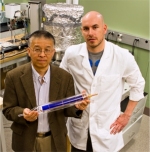
A collaborative research team from the Massachusetts Institute of Technology (MIT) and Boston College have developed a small-scale thermoelectric solar device that uses flat-panel technology - much like conventional silicon photovoltaic solar panels - to harness the sun's heat and produce power up to eight times more efficiently than other devices based on solar thermoelectric technology.

The beauty of the device, according to MIT Professor in Power Engineering, Gang Chen, lies in its simplicity. Like a photovoltaic module based system, it has no moving parts. The device consists of a thermoelectric generator placed inside a vacuum chamber made of glass, covered with a black plate of copper that absorbs sunlight but does not re-radiate it as heat. The other side of the generator is in contact with ambient temperatures. Even when not in direct sunlight, the generator is capable of harnessing a temperature difference of 200 degrees Celsius between the interior and exterior of the system to generate electricity.

The concept "is very radical," Chen says, and because the MIT device requires much less expensive materials to manufacture than traditional solar panels, the cost vs. energy output could become a superior clean energy choice in the future once the technology is properly developed.

By installing small-scale solar thermoelectric devices onto existing solar hot water systems, households could also produce electricity and further reduce greenhouse gas emissions.

Li Shi, associate professor of mechanical engineering at the University of Texas at Austin, says the thermoelectric approach to solar power is "very novel, simple, and easy for low-cost implementation." The efficiency level they have demonstrated so far, at 4.6 percent, is "already quite impressive," he says.

Source:   Energy Matters

Thursday, November 11, 2010

M.I.T. researchers develop portable solar desalination syst


Researchers from the Massachusetts Institute of Technology designed a portable water desalination system designed for emergency use and for far-flung areas where drinkable water is scarce.
Though designed initially for servicing emergency situations, the technology can also be used in remote areas where supplying energy and clean water can be logistically complex and expensive, the researchers said.
During emergencies such as rescue operations or disaster situations, access to both water and power is limited.
The team from the institute’s Field and Space Robotics Laboratory said the solar-powereddesalination system can be rapidly deployed.
Led by Steven Dubowsky, a professor in the department of mechanical engineering and the department of aeronautics and astronautics, the group built a small prototype that demonstrated the system’s capability to produce 80 gallons of water daily in a variety of weather conditions.
The team estimated that a larger version of the unit, which can cost about $8,000 to assemble, can provide about 1,000 gallons of water per day.
The system relies on reverse osmosis, a filtration method that removes molecules and ions such as salt from solutions by applying pressure to the fluid as it flows over a permeable membrane.
This process begins as photons, or particles of light from the sun, fall onto a solar photovoltaic panel and excite electrons in the PV cells. This activity generates electric power that pushes seawater through various pumps until it is sent — at extremely high pressure — into a vessel that has a permeable membrane made of polymer material.
As a result of the high pressure, the water that diffuses through the membrane has had minerals removed.
The project is part of a joint research collaboration between the M.I.T. and the King FahdUniversity of Petroleum and Minerals in Saudi Arabia. It is funded through the Center for Clean Water and Clean Energy.

Source:   EcoSeed

Monday, September 13, 2010

Nanotubes could change the way we harvest solar energy

MIT chemical engineers have found that by using carbon nanotubes (hollow tubes of carbon atoms) solar energy can be concentrated 100 times more than a regular photovoltaic cell.

Such nanotubes could form antennas that capture and focus light energy, potentially allowing much smaller and more powerful solar arrays.

Michael Strano, the Charles and Hilda Roddey Associate Professor of Chemical Engineering and leader of the research team and his students tell that their new carbon nanotube antenna, or “solar funnel” might also be useful for any other application that requires light to be concentrated, such as night-vision goggles or telescopes.

Solar panels generate electricity by converting photons (packets of light energy) into an electric current, reports Nature.

Strano’s nanotube antenna boosts the number of photons that can be captured and transforms the light into energy that can be funneled into a solar cell.

The antenna consists of a fibrous rope about 10 micrometers (millionths of a meter) long and four micrometers thick, containing about 30 million carbon nanotubes. Strano’s team built, for the first time, a fibre made of two layers of nanotubes with different electrical properties - specifically, different bandgaps.

In any material, electrons can exist at different energy levels. When a photon strikes the surface, it excites an electron to a higher energy level, which is specific to the material. The interaction between the energized electron and the hole it leaves behind is called an exciton, and the difference in energy levels between the hole and the electron is known as the bandgap.

The inner layer of the antenna contains nanotubes with a small bandgap, and nanotubes in the outer layer have a higher bandgap. That’s important because excitons like to flow from high to low energy. In this case, that means the excitons in the outer layer flow to the inner layer, where they can exist in a lower (but still excited) energy state.

Therefore, when light energy strikes the material, all of the excitons flow to the centre of the fibre, where they are concentrated. The study has been published in the Sept. 12 online edition of the journal Nature Materials.

Source:   The Hindu

Monday, May 10, 2010

MIT Researchers Print Solar Cell on Paper


Scientists at the Massachusetts Institute of Technology have successfully coated paper with a solar cell, part of a suite of research projects aimed at energy breakthroughs.

The printed solar cells, which Bulovic showed at a press conference Tuesday, are still in the research phase and are years from being commercialized.

However, the technique, in which paper is coated with organic semiconductor material using a process similar to an inkjet printer, is a promising way to lower the weight of solar panels. "If you could use a staple gun to install a solar panel, there could be a lot of value," Bulovic said.

The materials MIT researchers used are carbon-based dyes and the cells are about 1.5 percent to 2 percent efficient at converting sunlight to electricity. But any material could be used if it can be deposited at room temperature, Bulovic said. "Absolutely, the trick was coming up with ways to use paper," he said.

Source:   CNET News - Read the full article here.